


 )
hoặc https:// có nghĩa là bạn đã kết nối an toàn với trang web .gov. Chỉ chia sẻ thông tin nhạy cảm trên các trang web chính thức, an toàn.
)
hoặc https:// có nghĩa là bạn đã kết nối an toàn với trang web .gov. Chỉ chia sẻ thông tin nhạy cảm trên các trang web chính thức, an toàn.


- 8.17.3 Preparing a Statement of Account
- 8.17.3.1 Program Scope and Objectives
- 8.17.3.1.1 Background
- 8.17.3.1.2 Authority
- 8.17.3.1.3 Responsibilities
- 8.17.3.1.4 Program Reports
- 8.17.3.1.5 Acronyms
- 8.17.3.2 Related Resources
- 8.17.3.3 Explanation of the Statement of Account
- 8.17.3.3.1 Statement of Account Requirements Defined
- 8.17.3.3.2 Requesting a Statement of Account
- 8.17.3.4 Preparation of the Statement of Account (Form 3623)
- 8.17.3.4.1 Revised Liability Line
- 8.17.3.4.2 Assessments Section
- 8.17.3.4.3 Payments Section
- 8.17.3.4.4 Overpayments
- 8.17.3.4.5 IRC 6211(b)(4) Refundable Credits
- 8.17.3.4.6 Barred Overpayments and Deficiencies
- 8.17.3.4.7 Collection Due Process (CDP) Cases
- 8.17.3.4.8 Jeopardy/Termination Assessments
- 8.17.3.4.9 Shared Responsibility Payment (SRP)
- 8.17.3.5 Identifying Prior Adjustments/Assessments
- 8.17.3.6 U.S. Tax Court Jurisdiction of Interest, Certain Penalties, and the SRP
- 8.17.3.7 Allocating Payments
- 8.17.3.8 Advance Payments of Unassessed Liabilities, IRC 6603, and Cash Bonds
- 8.17.3.8.1 IRC 6603 Deposits - Statement of Account Procedures
- 8.17.3.8.2 Identifying Deposits on Transcripts
- 8.17.3.9 Impact of the Estate of Smith Decision in Overpayment Cases
- Exhibit 8.17.3-1 Code Section for Overpayments - Bottom of Form 3623
- Exhibit 8.17.3-2 Statement of Account - Non-Jurisdictional Issues Provided as Information Only
- Exhibit 8.17.3-3 Settlement Computations - Overpayment with Frozen Refund, plus Earned Income Credit and Additional Child Tax Credit Adjustment
- 8.17.3.1 Program Scope and Objectives
Part 8. Appeals
Chapter 17. Settlement Computations and Statutory Notices of Deficiency
Section 3. Preparing a Statement of Account
8.17.3 Preparing a Statement of Account
Manual Transmittal
January 21, 2026
Purpose
(1) This transmits a revised IRM 8.17.3, Settlement Computations and Statutory Notices of Deficiencies, Preparing a Statement of Account.
Material Changes
(1) Modified IRM 8.17.3.1, Program Scope and Objectives, to include program office contact information.
(2) Added new IRM 8.17.3.1.1, Background, to include a brief overview of information pertinent to the program.
(3) Modified IRM 8.17.3.1.3, Responsibilities, to provide general information on who is responsible for the activities in the IRM section.
(4) Added new IRM 8.17.3.1.4, Program Reports, to clarify details of reporting.
(5) Added new IRM 8.17.3.2, Related Resources, to list sources employees use to conduct work and to include Taxpayer Bill of Rights (TBOR) content based on guidance from the Division Counsel/Associate Chief Counsel (National Taxpayer Advocate Program) and Branch 3 of the Associate Chief Counsel (Procedure and Administration), and add content related to IRM 25.30.2.3, Statement of Commitment, Service Level Agreement (SLA) between Appeals and Taxpayer Advocate Service (TAS).
(6) Since Rev. Proc. 84-58 was superseded by Rev. Proc. 2005-18, the following sections were modified: IRM 8.17.3.8, Advance Payments of Unassessed Liabilities, IRC 6603, and Cash Bonds, and IRM 8.17.3.8.1, IRC 6603 and Cash Bonds - Statement of Account Procedures, to remove detailed procedures applicable to deposits received in years 2004 and 2005, because Rev. Proc. 84-58 is no longer effective with respect to remittances after March 2005, and obsoleted Exhibit 8.17.3-1, Statement of Account - Overpayment and Cash Bond Present, because the bond example is no longer correct.
(7) Editorial changes have been made throughout this IRM. Legal references, code sections and IRM references were reviewed and updated.
Effect on Other Documents
This supersedes IRM 8.17.3 dated September 3, 2019.Audience
Office of Chief Counsel (Counsel) and IRS Independent Office of Appeals (Appeals) employees who prepare and/or use statements of account.Effective Date
(01-21-2026)
Steven M. Martin
Director, Operations Support
-
Purpose: The purpose of this IRM section is to provide guidance to the IRS Independent Office of Appeals (Appeals) Tax Computation Specialists (TCSs) for the accurate and efficient preparation of statements of account on cases worked in Appeals.
-
Audience: The primary users of the IRM section are Appeals TCSs and Appeals Technical Employees (ATEs).
-
Policy Owner: Policy, Planning, Quality and Analysis (PPQ&A) is under the Director, Operations Support (OS).
-
Program Owner: Appeals Policy is the program office responsible for providing technical and procedural guidance to the Appeals organization and is under the Director, PPQ&A.
-
Contact Information: Appeals employees should follow established procedures on How to Contact an Analyst. Other employees should contact the product content owner shown on the product catalog information page for this IRM.
-
This section covers procedures for preparing statements of account on cases worked in Appeals.
-
As stated in IRC 7803(e)(3), the Appeals mission is to resolve Federal tax controversies without litigation on a basis that is fair and impartial to both the Government and the taxpayer, promotes a consistent application and interpretation of, and voluntary compliance with, the Federal tax laws, and enhances public confidence in the integrity and efficiency of the IRS. Appeals accomplishes its mission by considering protested and U.S. Tax Court cases and negotiating settlements in a manner which ensures Appeals employees act in accord with the TBOR in every interaction with taxpayers.
-
IRM 8.17, Settlement Computations and Statutory Notices of Deficiency, establishes the TCS policy framework for Appeals.
-
The Director, OS, is responsible for Appeals’ policy and procedural guidance.
-
The Director, PPQ&A, is the program manager responsible for program oversight.
-
The policy analyst shown on the Product Catalog page as the originator is the assigned author of this IRM.
-
The Director, PPQ&A, provides trend and data analyses and detailed summary reports for Appeals.
-
See IRM 8.1.1-1, Common Terms Used in Appeals, for common terms and definitions used in IRM Part 8.
-
See the table below for the most common acronyms in this IRM section:
Acronym Definition ACDS Appeals Centralized Database System ACM Appeals Case Memorandum AO Appeals Officer APS Account and Processing Support ATCL Appeals Team Case Leader ATCTM Appeals Tax Computation Team Manager ATE Appeals Technical Employee ATM Appeals Team Manager CCDM Chief Counsel Directives Manual CIC Coordinated Industry Case IC Industry Case IDRS Integrated Data Retrieval System IMS Issue Management System LB&I Large Business and International LIN LB&I Image Network RAR Revenue Agent Report SB/SE Small Business/Self-Employed TCS Tax Computation Specialist
-
This IRM is the primary source of guidance on this program for Appeals.
-
The TBOR lists rights that already existed in the tax code, putting them in simple language and grouping them into 10 fundamental rights. Employees are responsible for being familiar with and acting in accord with taxpayer rights. See IRC 7803(a)(3), Execution of Duties in Accord with Taxpayer Rights. For additional information about the TBOR, see https://www.irs.gov/taxpayer-bill-of-rights.
-
In accordance with IRM 25.30.2.3, Statement of Commitment, Appeals will work collaboratively with the Taxpayer Advocate Service (TAS) to enhance the taxpayer experience. For more information, see IRM 25.30.2, Service Level Agreement between the IRS Independent Office of Appeals and the Taxpayer Advocate Service.
-
A Form 3623, Statement of Account, is prepared for certain docketed cases. The statement of account shows each tax year's correct liability, dates, and amounts of assessments, overassessments and abatements, and the resulting deficiency in assessment or overassessment. It also shows the dates and amounts of payments, credits and refunds, and the balance due or overpayment.
-
The Form 3623 is only prepared by the Appeals TCS. ATEs should not prepare statements of account. IRM 8.17.3.3.2, Requesting a Statement of Account, provides instructions on how to request a statement of account from TCS when it is determined that one is required.
-
Secure a current transcript of account before preparing the statement of account. A current transcript is generally one secured within the last two weeks. Request an updated transcript if anything indicates something transpired on the account since the last transcript was secured.
-
Statements of account are required in docketed cases involving:
-
Unpaid assessments of tax or penalty;
-
Overpayments;
-
Frozen refunds;
-
Interim payments after mailing 90-day letter;
-
Interim assessments after mailing 90-day letter;
-
Rule 155 computations, except where a short format computation is used; and
-
Jeopardy, termination, or prompt assessment cases.
-
-
A statement of account may also be required in unusual cases, such as some transferee cases. See IRM 8.7.5, Transferee and Transferor Liabilities.
-
A statement of account is generally not required for the following types of settled cases:
-
Non-docketed cases;
-
No change cases (unless a statement of account is needed for one of the reasons listed in IRM 8.17.3.3, Explanation of the Statement of Account, paragraph (4), such as an interim assessment or an overpayment);
-
Cases where there is no overpayment, no interim assessment, and there is a zero module balance on the transcript; and
-
Joint Committee cases (unless one is required for reasons other than Joint Committee status, such as a docketed overpayment case).
-
-
This section provides further discussion of some of the circumstances which require a statement of account, as described in IRM 8.17.3.3, Explanation of the Statement of Account.
-
Unpaid assessments of tax or penalty - A transcript will reflect a balance due because of the unpaid assessment. Examples of assessments that may be partially or fully unpaid include:
-
Tax due from original filing,
-
Partial agreement,
-
Taxable amended return, and
-
Assessment made after the notice of deficiency was mailed.
-
-
Overpayments - Examples of situations which may result in overpayments include:
-
Credit balance on the transcript as a result of an unassessed advance payment, see IRM 8.17.3.7, Allocating Payments, for definition of "unassessed advance payment" ;
-
Credit balance on the transcript as a result of a frozen refund;
-
Payments made with an unprocessed return as a result of substitute for return (SFR) or automated substitute for return (ASFR) proceedings;
-
Additional withholding credits allowable by Appeals or Counsel; and
-
Overpayment created as a result of a decrease in tax liability (overassessment); "Overassessment" refers to when line 21 of Form 5278, Statement - Income Tax Changes, or line 14 of Form 4549, Report of Income Tax Examination Changes, or Form 4549-A, Report of Income Tax Examination Changes (Without Taxpayer Signature), reflects a decrease.
-
-
Frozen refunds - Frozen refund cases are those selected for examination prior to scheduling refunds claimed on returns. The IRS identifies issues that may indicate a taxpayer is not truly entitled to the refund amount claimed. An example of a frozen refund case is listed below:
-
Taxpayers may claim large refundable credits, which may be frozen by the campus pending examination of the return.
-
-
Interim payments after mailing 90-day letter:
-
The taxpayer may have made a payment after the mailing of the 90-day letter that has not been assessed.
-
A credit balance on the transcript may be due to an interim payment.
-
-
Interim assessments after mailing 90-day letter - An interim assessment is an assessment (other than a jeopardy assessment) of tax and/or penalties made after the notice of deficiency was mailed. The assessment can be unpaid, partially paid, or paid in full. Some examples of interim assessments are listed below:
-
Delinquent return assessed after the notice of deficiency was mailed,
-
Payment assessed after the notice of deficiency was mailed,
-
Amended return assessed after the notice of deficiency was mailed, and
-
Assessment based on a signed waiver.
-
-
Rule 155 computations, except where a short format computation is used. See IRM 8.17.2.12.3, Statement of Account, for more information.
-
Jeopardy, termination, or prompt assessment cases;
-
Jeopardy assessment: A jeopardy assessment is made in situations where prior to the assessment of a deficiency or tax, it is determined that collection of such deficiency or tax would be endangered if regular assessment and collection procedures are followed.
-
Termination assessment: Termination assessments are very similar to jeopardy assessments except that under the provisions of IRC 6851, they are made only for the current or immediately preceding taxable year and can be made at any time prior to the due date for filing those years' returns.
-
Prompt assessment: A prompt assessment is made if collection appears to be at risk and the intention is to protect the government’s interest and revenue. See IRM 4.38.1.7.3.4, Quick Assessments, and IRM 5.1.4, Jeopardy, Termination, Quick and Prompt Assessments, for more information.
-
-
When the TCS prepares a settlement computation for an ATE or Counsel, the TCS will determine if a statement of account is required and prepare Form 3623, if one is needed. The TCS will forward a copy of the transcript used in preparing the computations.
-
ATEs who prepare their own settlement computations, or who secure agreement on a docketed case that does not require a settlement computation, must follow the procedures shown in IRM 8.2.1.8, Requesting Work From Tax Computation Specialist, when a statement of account is required.
-
If a statement of account is required for a Counsel case that wasn't sent to TCS for settlement computations, Counsel must either send a secure e-mail request for the Form 3623 preparation to the applicable TCS manager or submit a request using the Appeals Shared Programs Hub - Home site. Counsel should attach the following to the request:
-
Form 3608, Request for Tax Computation Specialist (TCS) Service, found on the Appeals TCS SharePoint site);
-
Copy of notice of deficiency letter, or include the date of notice of deficiency letter and list penalties by code section; and
-
Computations - attach either Report Generation Software (RGS)/Income Tax Planner (ITP) settlement computations or a copy of the notice of deficiency tax computation.
-
-
If a case does not involve an issue listed in IRM 8.17.3.3, Explanation of the Statement of Account, and the Counsel attorney thinks a statement of account is required, the attorney’s manager will need to approve the request.
-
The attorney should advise their manager that they think a statement of account is required for their case and why the statement of account is needed. The manager will approve or deny the request.
-
The approval needs to be in writing and the attorney needs to forward the approval to the applicable TCS manager. The communication to TCS needs to indicate why a statement of account is requested for the case.
-
The TCS manager will review the approval. If the TCS manager does not agree with the reasons given for why a statement of account is needed, the TCS manager should discuss the concerns with the Counsel manager in an attempt to reach a consensus as to whether a statement of account is needed. If a consensus cannot be reached, TCS will prepare the statement of account. Afterward, the TCS manager should elevate their concerns through the management chain of the TCS manager.
-
-
Excel Form 3623 spreadsheets are available on the TCS SharePoint site. Some important points to note about the Excel spreadsheets are listed below:
-
Enter the tax years at the top of the columns to activate the formulas embedded in the Excel spreadsheets.
-
Enter all numbers as positive numbers, including overassessments and payments, in order for the formulas to work.
-
-
Statement of account entries for the top of Form 3623 are discussed below:
-
Enter the name of the petitioner (taxpayer) in the name section.
-
Enter the schedule number or letter.
-
Enter the kind of tax in the appropriate sections on the form.
-
Insert the docket number in the space provided. Prepare a separate statement of account for each docket number.
-
Show tax and additions to the tax or penalties in separate columns.
-
-
List the assessments and payments of tax and penalties. Prepare the statement of account so that the U.S. Tax Court can separately determine the deficiency or overpayment of tax and penalty.
-
If a penalty asserted in the notice of deficiency is conceded in full, or is no longer applicable, then the penalty does not need to be listed on the statement of account unless one of the circumstances described in IRM 8.17.3.3 exists for the penalty (such as an overpayment of the penalty or an interim assessment of the penalty). Show the code section rather than the name of each penalty. See IRM 8.17.3.4.1, Revised Liability Line, for the format to use if the IRC 6651(a)(2) , failure to pay penalty, is still accruing.
-
The statement of account consists of an assessment section and a payment section. In each section, there is a "Revised Liability" line. Enter the total liability for tax and penalty as finally determined, on the revised liability line.
-
The revised liability in tax amount is generally line 18 from Form 5278 (or line 11 from Form 4549 and Form 4549-A), unless the special format for refundable credits, such as earned income credit and additional child tax credit, is used. See IRM 8.17.3.4.5, IRC 6211(b)(4) Refundable Credits, for discussion of this format.
-
If the IRC 6651(a)(2) penalty is still accruing:
-
Per IRM 8.17.7.5.2, Failure to File and Failure to Pay Computations for SFR Returns, if the Failure to Pay (FTP) penalty is still accruing and has not reached the maximum penalty of 25%, the FTP penalty amount is shown as an asterisk on the tax computation form. Language is also included in the settlement computation to explain that the amount cannot be determined.
-
When the tax computation shows an asterisk for the FTP penalty, use an asterisk for the penalty amount on the statement of account. Suggested sample language that can be used is Amount to be determined or To be computed later.
-
-
No change cases - Sometimes a Form 3623 is prepared for a no change case, such as when there is an overpayment in tax and/or penalty, or an unpaid assessment of tax and/or penalty.
-
If a Form 3623 is being prepared for a no change case, then the revised liability amount for tax will be the transaction code (TC) 150 posting plus any TC 29X or 30X postings shown on the transcript.
-
Penalties: If a statement of account is being prepared for a no change case, a penalty asserted in the notice of deficiency only needs to be included on the statement of account if one of the circumstances in IRM 8.17.3.3 exists for the penalty (such as an overpayment of the penalty or an unpaid assessment of the penalty). In such a case, if penalties asserted in the notice of deficiency were assessed on the transcript, then the revised liability amount for penalties will be the amount shown as assessed.
-
-
In the assessment section, show amounts and dates of assessments and overassessments (including abatements) from the transcript of account.
-
Assessment (tax on return) line:
-
Enter amount of the return tax assessment shown on the transcript. This is generally the TC 150 amount, unless the special format for refundable credits, such as earned income credit (EIC) and additional child tax credit (ACTC), is used. See IRM 8.17.3.4.5 for details of this format.
-
Enter the amount assessed for a delinquent return filed after the SFR proceedings have begun, whether the return was assessed before or after the issuance of the notice of deficiency. The assessment is generally posted with a TC 290.
-
-
Additional Assessments:
-
Enter the amount and date of each additional assessment shown on the transcript.
-
Additional assessments might include assessments of partial agreements, amended returns, and the assessment of payments received after the notice of deficiency was issued.
-
Generally, do not include assessments of penalties not shown in the notice of deficiency, and do not include interest assessments. However, see IRM 8.17.3.6, U.S. Tax Court Jurisdiction of Interest, Certain Penalties, and the SRP, for additional information.
-
-
Overassessments:
-
Show amounts and dates of overassessments, including abatements, from the current transcript.
-
Generally, do not include overassessments of penalties not shown in the notice of deficiency, and do not include interest abatements. However, see IRM 8.17.3.6 for additional information.
-
-
Enter payment dates and amounts from a current transcript.
-
Use the due date of the return for payments made on or before the due date, such as withholding tax, estimated tax payments, credit elects, credit transfers, etc. (Any amounts withheld, paid as estimated income tax, or otherwise paid prior to the return due date are considered to have been paid on the due date of the return.)
-
The payments made on or before the due date of the return may be listed separately, combined into categories (for example, all estimated tax payments totaled and shown as one amount), or all payments made by the due date of the return can be totaled and shown as one amount on the statement of account.
-
-
It is not necessary to describe the type of payment on the statement of account.
-
Be careful to allocate payments properly. Payment allocation depends on various factors such as:
-
Whether the payments were assessed or unassessed,
-
If the taxpayer designated the allocation of the payment,
-
If the payment was a cash bond or IRC 6603 deposit.
-
-
Generally, do not include payments of penalties not shown in the notice of deficiency, and do not include interest payment amounts. However, see IRM 8.17.3.6 for additional information.
-
IRC 6211(b)(4) refundable credits:
-
Refundable credits that are included in the definition of a statutory deficiency per IRC 6211(b)(4) include EIC, the refundable ACTC, first time homebuyer credit, recovery rebate credit, fuel tax credit, etc. See IRM 8.17.5.18.2, Adjustments to Refundable Credits Included in the Statutory Deficiency, for a complete list of IRC 6211(b)(4) refundable credits.
-
Adjustments to refundable credits require a special format per IRM 8.17.3.4.5.
-
If the format in IRM 8.17.3.4.5 is used, then the IRC 6211(b)(4) refundable credits aren't entered in the payments section on the statement of account.
-
-
Withholding Credits:
-
If additional withholding credits not shown on the transcript are allowed, and a statement of account is prepared, include the amounts on the statement of account in the payments section using the due date of the return.
-
It is helpful to include a notation that these withholding credits are in addition to the amounts shown on the transcript.
-
-
Refunds or Credit section:
-
Enter refund amounts, such as TC 846 (computer generated refund) or TC 840 (manual refund).
-
Enter overpayment credits transferred to another account. The most common TCs are TC 826 or 820 and TC 836 or 830.
-
The use of the word credit on Form 3623 in the Refunds or Credit section does not mean withholding credits, EIC, ACTC, advance on child tax credit, rate reduction credit, or any other refundable credit.
-
List each refund or credit separately by date and TC. (A TC 836 would be listed separately from a TC 846, even if they both have the same date, since they are different types of transactions). It is not necessary to describe the type of refund or credit on the statement of account.
-
Do not show on Form 3623 any overpayment interest amount (TC 770 or TC 776) included in a TC 840 or TC 846 refund total. Any refundable interest (TC 770 or TC 776) included in the TC 840 or TC 846 totals must be subtracted before entering the remaining TC 840 or TC 846 amount on the Form 3623.
-
When the refund or credit is posted before the return due date, the actual date on the transcript or the return due date can be entered on the statement of account.
-
-
Advance Refunds:
-
Various statutes provide taxpayers with advance refunds. Advance refunds are seldom adjusted. They are posted with a TC 766, and the credit reference number (CRN) identifies the type of credit.
-
Include the TC 766 advance refund amount as a payment in the payments section of the statement of account.
-
Include the related TC 846 refund amount in the "Refunds or Credit" section of the statement of account.
-
Generally, the date to include on statement of account for an advance refund is the date shown on the transcript for the TC 766 amount, not the due date of the return.
-
-
If payments are designated incorrectly on the transcript of account, notify the ATE of the error. The ATE should request a correction by Account and Processing Support (APS).
-
Complete the section at the bottom of Form 3623 if there is an overpayment:
-
Tax Year Ended - Enter any tax year that has an overpayment. It can be an overpayment in tax or an overpayment in a penalty, or both.
-
Year – This field may be omitted, since Counsel's stipulations do not include the year of the IRC. If completed, enter "1986" . This field is for the latest complete revision of the IRC, which is 1986.
-
Section - The applicable IRC sections must be entered at the bottom of Form 3623. IRC 6512 gives the U.S. Tax Court authority to determine an overpayment. IRC 6511 imposes the limitation on the amount of the overpayment. See Exhibit 8.17.3-1, Code Section for Overpayments - Bottom of Form 3623. This exhibit provides an explanation of the overpayment code sections to use for statements of account.
-
Date Return Filed - Obtain the date from the transcript. For SFR or ASFR cases, you can indicate that the taxpayer did not file a return by using SFR, ASFR, No return filed, or None.
-
Date Agreement Signed - This is the date the Form 872, Consent to Extend the Time to Assess Tax, or Form 872-A, Special Consent to Extend the Time to Assess Tax, was countersigned by the IRS, not the date the taxpayer signs the form. The ATE or Counsel may need to provide the TCS with this information.
-
Statute Extended To - Obtain this date from the statute extension Form 872. If Form 872-A was used, enter "872-A" instead of a date. The ATE or Counsel may need to provide the TCS with this information.
-
Date Deficiency Notice Mailed - This is the “Letter Date” field on the notice of deficiency Letter 894, Notice of Deficiency - Deficiencies in Income Tax, and Letter 901, Statutory Notice. The ATE or Counsel may need to provide the TCS with this information.
-
Date Claim Filed - Complete when a valid claim for refund was filed before the notice of deficiency was issued. The ATE or Counsel may need to provide the TCS with this information.
-
Amount of Claim - Use the amount of refund requested on a valid claim for refund filed before the notice of deficiency was issued that has not been allowed. For a frozen refund case, use the amount of refund shown on the taxpayer’s return. (Use the amount of refund shown on the taxpayer's return even if part of the claimed refund has already been refunded.)
-
-
However, certain types of overpayments don't require the section at the bottom of Form 3623 to be completed:
-
Total overpayment is barred - See IRM 8.17.3.4.6, Barred Overpayments and Deficiencies.
-
Collection Due Process (CDP) case - See IRM 8.17.3.4.7, Collection Due Process (CDP) Cases.
-
-
The section at the bottom of Form 3623 must be completed when there is an overpayment, except as noted in paragraph (2) above. Counsel attorneys will be advised to return Forms 3623 in overpayment cases, which do not have the bottom section completed when required.
-
This section addresses how to prepare a statement of account when adjustments are made to refundable credits that are included in the definition of a statutory deficiency per IRC 6211(b)(4).
-
Examples of IRC 6211(b)(4) refundable credits are EIC, the refundable ACTC, first time homebuyer credit, recovery rebate credit, fuel tax credit, etc. See IRM 8.17.5.18.2, Adjustments to Refundable Credits Included in the Statutory Deficiency, for a complete list of these refundable credits.
-
A statement of account is not required simply because there are adjustments to IRC 6211(b)(4) refundable credits. However, if a statement of account is required as outlined in IRM 8.17.3.3 and IRC 6211(b)(4) refundable credits are adjusted, follow the procedures outlined in this section.
-
When a statement of account is prepared and changes are made to IRC 6211(b)(4) refundable credits, see instructions below for how to compute the Revised Liability and Assessment (tax on return) lines:
-
"Revised Liability" : Decrease the corrected income tax liability amount by the amount of the corrected refundable credits and enter the result on the "Revised Liability" lines of Form 3623. (Use the corrected amount of refundable credits instead of the amount of the adjustment to the refundable credits.)
-
"Assessment (tax on return)" : Decrease the assessed tax per return by the amount of the assessed refundable credits and enter the result on the "Assessment (tax on return)" line of Form 3623.
-
-
Do not show the IRC 6211(b)(4) refundable credits claimed on the return and posted to the taxpayer’s account in the payments section since these amounts are considered in the liability section.
-
Also include the exact amount refunded to the taxpayer in the payments section regardless of whether the refund included any of these credits.
-
See Exhibit 8.17.3-3, Settlement Computations - Overpayment with Frozen Refund, plus Earned Income Credit and Additional Child Tax Credit Adjustment, for an example of adjustments to both the EIC, and the refundable ACTC, on Form 3623. This example also has a frozen refund and the result is an overpayment.
-
Excel Form 3623 spreadsheets that can assist you with cases involving adjustments to the IRC 6211(b)(4) refundable credits are accessible on the TCS SharePoint site. Both the "General" and "Individual" spreadsheets folder have a "Form 3623 Refundable Credits" Excel file which has formulas and drop down menus which allow you to select the appropriate refundable credit.
-
If the IRC 6211(b)(4) credits claimed on the return aren't adjusted in the settlement or Rule 155 computation and a statement of account is prepared, the format discussed in this section to show the refundable credits can be used, but it's not required. If the refundable credit format shown in this section isn't used, instead enter the amount of IRC 6211(b)(4) credits shown on the transcript in the payments section of Form 3623.
-
For a list of current examples of refundable credits, please see the TCS SharePoint site.
-
If total overpayment or deficiency is barred:
-
No annotation is required on Form 3623 , if a footnote is included on the Form 3610, Audit Statement, or the tax computation form.
-
However, if a statement of account is prepared, the barred amount may be notated with an asterisk (*), and a footnote added to Form 3623. The following is an example of the footnote on Form 3623 for a barred overpayment case:
"Overpayment barred by statute of limitations."
-
-
If only part of the overpayment or deficiency is barred:
-
The total amount may be asterisked (*), and a short summary of the barred amount added to the bottom of the Form 3623. The following is an example of the summary for a case when only part of the overpayment is barred:
Overpayment $6,000.00 Overpayment Barred by Statute of Limitations 1,000.00 Overpayment Allowable $5,000.00
========
-
-
If there is a barred overpayment or deficiency for a CDP case, see IRM 8.17.3.4.7 for requirements.
-
Preparing a statement of account for a CDP case can involve a number of complicated legal determinations; therefore, due to the complex nature of CDP cases, see following discussion:
-
When there is an overpayment for a CDP case, the TCS is not required to complete the bottom section of Form 3623. The ATE or Counsel attorney will need to determine the information to include in the stipulation.
-
Notations to indicate a barred overpayment or deficiency are not required on a statement of account prepared for a CDP case. The ATE or Counsel attorney will need to determine the appropriate information to include in the stipulation.
-
-
A jeopardy assessment, made prior to the issuance of a notice of deficiency, is not taken into consideration in determining the statutory deficiency. In such cases, show the following on the statement of account:
-
The deficiency in tax and penalty before the jeopardy assessment,
-
The deficiency or overassessment of tax and penalty after considering the jeopardy assessment, and
-
The underpayment or overpayment of tax and penalty. (The underpayment or overpayment of tax and penalty before the jeopardy assessment should be the same as the underpayment or overpayment of tax and penalty after the jeopardy assessment.)
-
-
Statement of account formats for jeopardy assessment cases:
-
The statement of account can have one column, to reflect the deficiency in tax and penalty before the jeopardy assessment, and another column for the deficiency or overassessment of tax and penalty after considering the jeopardy assessment; or
-
Two separate statements of account can be used.
-
-
See IRM 8.17.5.22 , Jeopardy Assessments in Settlement Computations, for more information about jeopardy assessments.
-
Handle termination assessments under IRC 6851 similar to jeopardy assessments.
-
The statutory notice of deficiency procedures do not apply to the individual shared responsibility payment (SRP) itself. However, there may be adjustments to the SRP or other SRP issues in a case (e.g., an income tax case) where deficiency procedures do apply. Generally, in these cases, whether for purposes of preparing settlement computations, or for purposes of preparing a notice of deficiency, TCS will recalculate Master File Tax (MFT) 30 and MFT 35 SRP, based on adjustments to income, following normal procedures. See IRM 8.17.2, General Settlement and Rule 155 Computations. The SRP may appear on the calculations attached to a notice of deficiency, but the SRP amount must not be included in the deficiency amount because it is not subject to the U.S. Tax Court’s jurisdiction.
-
The ATE should indicate on the schedule of adjustments whether the SRP is being adjusted and the amount reported per return.
-
The ATE should also consider the following items when adjusting the SRP:
-
Income tax return;
-
Date of birth of any dependents (if applicable);
-
Household income (including income of those dependents whose income meets the income tax return filing threshold);
-
Months during the taxable year the taxpayer was or was not covered by insurance, including dependents (if applicable);
-
Form 1095-A, Health Insurance Marketplace Statement, (if applicable);
-
Form 1095-B, Health Coverage, (if applicable);
-
Form 1095-C, Employer-Provided Health Insurance Offer and Coverage, (if applicable); and
-
Form 8965, Health Coverage Exemptions, (if applicable).
-
-
When the ATE indicates that the SRP is an adjustment, TCS will recalculate MFT 30 and MFT 35 SRP, based on adjustments to income, following normal procedures. A link to the SRP calculator is found on the Appeals ACA Webpage.
-
If there is no change to the SRP, TCS will include a notation in their case activity record and email the requesting ATE that there is no change to the SRP.
-
Form 3610, is recommended for cases involving the SRP.
-
See TCS SharePoint site for sample computation forms and Form 5403, Appeals Closing Record, containing special language required for SRP and Knowledge Management Individual Shared Responsibility Payment Page for more details.
-
If there is an adjustment to the SRP, the calculation will be shown on a schedule included with the computations.
-
Penalties under IRC 6651, IRC 6654, and IRC 6656 are computer generated.
-
Campus adjustments, subsequent to the posting of the return (the TC 150 transaction), sometimes carry a second Document Locator Number (DLN) with a 54 document code (4th and 5th digits of DLN).
-
Except for partial agreements, prior Compliance or Appeals action for master file and non-master file returns generally have a second DLN with a 47 document code (4th and 5th digits of DLN).
-
Jeopardy, quick, and prompt assessments for master file accounts have a 51 document code.
-
If the file contains a Form 1139, Corporation Application for Tentative Refund, or Form 1045, Application for Tentative Refund, (used by individual taxpayers), there may be a prior abatement. A TC 295 indicates that a Form 1139 or Form 1045 was filed.
-
The DLN on an amended return does not indicate there was an assessment or overassessment. Further, a duplicate filing condition may exist on the master file, which requires special handling by the campus, to permit an adjustment to post. A TC 976 may indicate a duplicate posting condition. A TC 290 or TC 291 may indicate that an amended return was processed.
-
Erroneous (premature) assessments of the notice of deficiency:
-
Occasionally, a transcript will reflect a premature assessment, when the deficiency shown in a notice of deficiency has been assessed, despite the taxpayer timely filing a valid petition in U.S. Tax Court. Generally, there is a disposal code 10 on the transcript, which means a defaulted notice of deficiency. This is an erroneous assessment, which the ATE or Counsel attorney usually will have abated.
-
Since these assessments normally will be abated, the assessment and corresponding abatement generally are not shown on the statement of account.
-
If the erroneous assessment of the notice of deficiency is going to be abated, and the abatement of the notice of deficiency assessment has not posted yet, the assessment of the notice of deficiency shown on the transcript should not be included on the statement of account.
-
However, any payments of the notice of deficiency assessment will need to be shown on the statement of account.
-
The ATE or Counsel attorney must ensure that the abatement of the erroneous assessment has posted before closing the case.
-
-
The U.S. Tax Court does not have jurisdiction over the SRP, even though its amount may change, as a result of the deficiency proceedings. While a statement of account is not required if there are changes to the SRP, the computations may be very helpful to Counsel to prepare below-the-line stipulations on the decision documents, as further discussed in paragraph (2) below. The U.S. Tax Court may not have jurisdiction over interest provisions or certain penalties. Therefore, assessment and payment information are not included on the statement of account for these non-jurisdictional items. This means that:
-
Generally, interest amounts are not included on the statement of account; and
-
Usually, only penalties asserted in the notice of deficiency (if still applicable) are included.
-
-
However, it may sometimes be helpful to show assessment and payment information for items not under U.S. Tax Court jurisdiction, especially for the SRP.
-
Provide this information on a separate Form 3623, if combining it with the jurisdictional information creates confusion.
-
No matter where it is shown, non-jurisdictional items should be clearly labeled as "Information Only."
-
For SRP computations, if the SRP was reported on taxpayer’s return and paid by income tax offset prior to the U.S. Tax Court case, the offset from the MFT 30 income tax account to the MFT 35 SRP account will be shown on the statement of account in the Less Refunds and Credits section. Since this information will not be used by Counsel to prepare stipulations and decision documents, not all fields in the Information Only column on the statement of account need to be completed.
-
-
Payments of assessed tax, penalty, and interest:
-
When the taxpayer specifies how a partial payment of assessed tax, penalty, and interest is applied, reflect the allocation on the statement of account.
-
When the taxpayer does not specify an allocation, apply payments in accordance with Rev. Proc. 2002-26. Generally, if the amount applied to a tax period is less than the liability for the period, the amount of the payment will be applied to tax, penalty, and interest, in that order, until the payment is absorbed.
-
Generally, don't reallocate payments that were previously applied to tax, penalties, or interest (for example, don't reallocate payments to penalties once they have been previously applied to tax, and don't reallocate payments to tax that were previously applied to penalties).
-
-
Advance payments of unassessed liabilities:
-
Advance payments of unassessed liabilities are discussed in Rev. Proc. 2005-18. The term unassessed advance payments is also used for these types of payments. Both terms refer to advance payments which have been posted to the taxpayer’s account, but not applied to pay an assessment of tax, penalty, or interest since the liabilities are unassessed.
-
Allocate payments made towards unassessed liabilities in accordance with Rev. Proc. 2005-18. Unless the taxpayer specifically directed the manner of the application of an advance payment, the payment should be included in the "Tax" column on the statement of account.
-
Generally, only allocate payments to the penalty columns on the request of a Counsel attorney. Otherwise, usually the entire payment should be entered in the tax column even if this results in an overpayment, and penalties are being asserted in the settlement of the case.
-
-
Unassessed advance payments designated as deposits under IRC 6603 or as cash bond deposits are not included on the statement of account.
-
See IRM 8.17.3.8, Advance Payments of Unassessed Liabilities, IRC 6603, and Cash Bonds, and IRM 8.17.3.8.1, IRC 6603 Deposits - Statement of Account Procedures, for additional information.
-
-
The American Jobs Creation Act of 2004 added IRC 6603 to permit taxpayers to make deposits to suspend the running of interest on potential underpayments of tax.
-
IRC 6603 codifies the taxpayer's right to make a deposit in lieu of a payment to stop the running of interest on a potential deficiency and provides for the accrual of interest on a deposit returned to the taxpayer to the extent that the deposit is attributable to a disputable tax. IRC 6603 was enacted October 22, 2004.
-
Advance payments of unassessed liabilities are discussed in Rev. Proc. 2005-18, which applies to remittances made to stop the running of interest on deficiencies, including remittances treated as deposits under IRC 6603. Rev. Proc. 2005-18 discusses "deposits made pursuant to IRC section 6603," which replace the "deposits in the nature of a cash bond" discussed in Rev. Proc. 84-58. Rev. Proc. 84-58 is superseded, effective with respect to remittances made on or after March 28, 2005.
-
Unlike cash bonds, the taxpayer may be entitled to credit interest pursuant to IRC 6603(d) on a refunded portion of a deposit. The rate of interest allowed on returned deposits is lower than the rates for overpayments under IRC 6621(b). Credit interest on a returned deposit is computed at the federal short term rate, compounded daily. The Automated Computation Tool/Decision Modeling Inc. (ACT/DMI) Program provides a Federal Short Term Rate Chart specifically for computing interest on returned deposits.
-
Remittances submitted to suspend the running of interest under this section are referred to as 6603 deposits.
-
-
See IRM 20.2.4.9.2, IRC 6603 Deposits, for further information about IRC 6603 deposits.
-
Unassessed advance payments designated as deposits under IRC 6603 are not included on the statement of account.
-
Instead, include the following notation at the bottom of the statement of account: “A deposit made under IRC 6603 in the amount of $3,000.00 was received for the tax year 12/31/2022 on 06/16/2025.”
-
Cash bonds:
-
A cash bond is present if a 900 - 999 appears in digits 9, 10, and 11 of the DLN next to the TC 640 amount. It looks similar to the following:
TC DATE AMOUNT CYCLE DLN 640 12011996 2,000.00- 199552 55211-110-99922-1
-
-
IRC section 6603 deposits:
-
Remittances submitted after October 22, 2004, identified by taxpayers as IRC 6603 deposits are processed and posted in the same manner as the IRS previously processed a cash bond remittance. Deposits are identified by a TC 640, blocking series 999, and designated payment code (DPC) 12.
-
See IRM 20.2.4.9.1, Cash Bonds, and IRM 20.2.4.9.2, IRC 6603 Deposits, for additional information.
-
-
Converted deposits:
-
Because IRC 6603 deposits are processed and posted in the same manner cash bond deposits were previously processed, identifying deposits on a transcript that have been converted from cash bond deposits to IRC 6603 deposits requires a careful analysis of the case file.
-
Review the case file for the written statement that the taxpayer must submit to convert these previously posted cash bonds to IRC 6603 deposits.
-
The ATE or Counsel attorney may need to contact the taxpayer to obtain additional information to verify if a cash bond deposit was converted to an IRC 6603 deposit and the date of the conversion.
-
-
When preparing decision documents, stipulations, and Rule 155 cover sheets, the IRS has followed a long-standing practice of not reducing the amount of an overpayment in tax by the amount of any unpaid interest or penalties.
-
In Estate of Smith v. Commissioner, 123 T.C. 15 (2004), the U.S. Tax Court held that the amount of overpayment was the amount by which total payments exceeded tax, including any assessed underpayment interest, and that the IRS, therefore, could not reduce the petitioner’s refund for any outstanding underpayment interest not specified in the entered decision/stipulation.
-
As a result of the court decision in the Estate of Smith case, Counsel issued Notice CC-2004-035 advising Counsel attorneys that assessed and unassessed underpayment interest should be taken into account when preparing overpayment decision documents and stipulations.
-
In November of 2005, the decision in the Estate of Smith case was reversed by the Court of Appeals for the Fifth Circuit. Counsel issued Notice CC-2010-006. This notice revoked Notice CC-2004-035, and stated that it was inappropriate to include assessed or unassessed interest computations in decision documents, stipulations, and Rule 155 computations. This notice eliminated the requirement to prepare Estate of Smith computations for statements of account.
| For notice of deficiency cases, show Internal Revenue Code sections as IRC 6512(b)(3) and either (A), (B), or (C). If IRC 6512(b)(3)(B) or IRC 6512(b)(3)(C) is used, an IRC 6511 section must also be used. Select IRC 6511(b)(2), IRC 6511(c), or IRC 6511(d), whichever is applicable. |
|---|
| Explanation of Code Sections: |
| IRC 6512(b)(3)(A): The amount of money refunded is from money paid by the taxpayer (TP) after the date the Statutory Notice (SN) was mailed. It is not necessary to also include an IRC section 6511 cite with IRC section 6512(b)(3)(A). |
| IRC 6512(b)(3)(B): Cite this section where a claim for refund could have been timely made under IRC section 6511(b)(2), (c), or (d) on the date of the mailing of the notice of deficiency (whether or not the TP actually made the claim). |
| IRC 6512(b)(3)(C): The TP filed a refund claim before the mailing date of the SN, and the claim either (1) had not been disallowed before that mailing date, (2) disallowed before the mailing date, but a suit for refund would have been timely as of the mailing date, or (3) a suit for refund was timely filed (i.e., within the period specified by section 6532) before the mailing date. |
| IRC 6511(b)(2)(A): A refund claim was filed within three years of the date the return was filed. The taxpayer can get a refund or credit of the taxes paid within the 3-year period immediately before the date the claim was filed plus the period of any extension of time to file the return. |
| IRC 6511(b)(2)(B): Claim filed after three years of the date the return was filed, the TP can get refund of taxes paid within the 2-year period immediately before the date the claim was filed. |
| IRC 6511(b)(2)(C): No claim filed, the TP can get refund only for amount available to TP if a claim was filed on the date the refund is allowed. |
| IRC 6511(c): Statute extended by agreement to extend the time to assess tax (using Form 872 or Form 872-A). |
| IRC 6511(d) – Special periods of limitation for: |
| (1) Bad debts and worthless securities, |
| (2) Net operating loss or capital loss carryback, |
| (3) Foreign tax credit, |
| (4) Certain credit carrybacks, |
| (5) Self-employment tax in certain cases, |
| (6) Amounts included in income subsequently recaptured under qualified plan termination, and |
| (7) Uniformed services retired pay reduced as a result of disability compensation. |
| IRC 6511(b)(2), IRC 6511(c), IRC 6511(d), or IRC 6512(b)(3)(A) ,(B), and (C) should be shown on Form 3623, as applicable. |
| These code sections are used by Counsel to prove that the statute of limitations is open so a refund can be allowed. Since the statute can be open for many reasons, specify which ones and Counsel will use them in the stipulation signed by the taxpayers. The most commonly used are IRC 6512(b)(3)(B) and IRC 6511(b)(2). |
Please click here for the text description of the image.
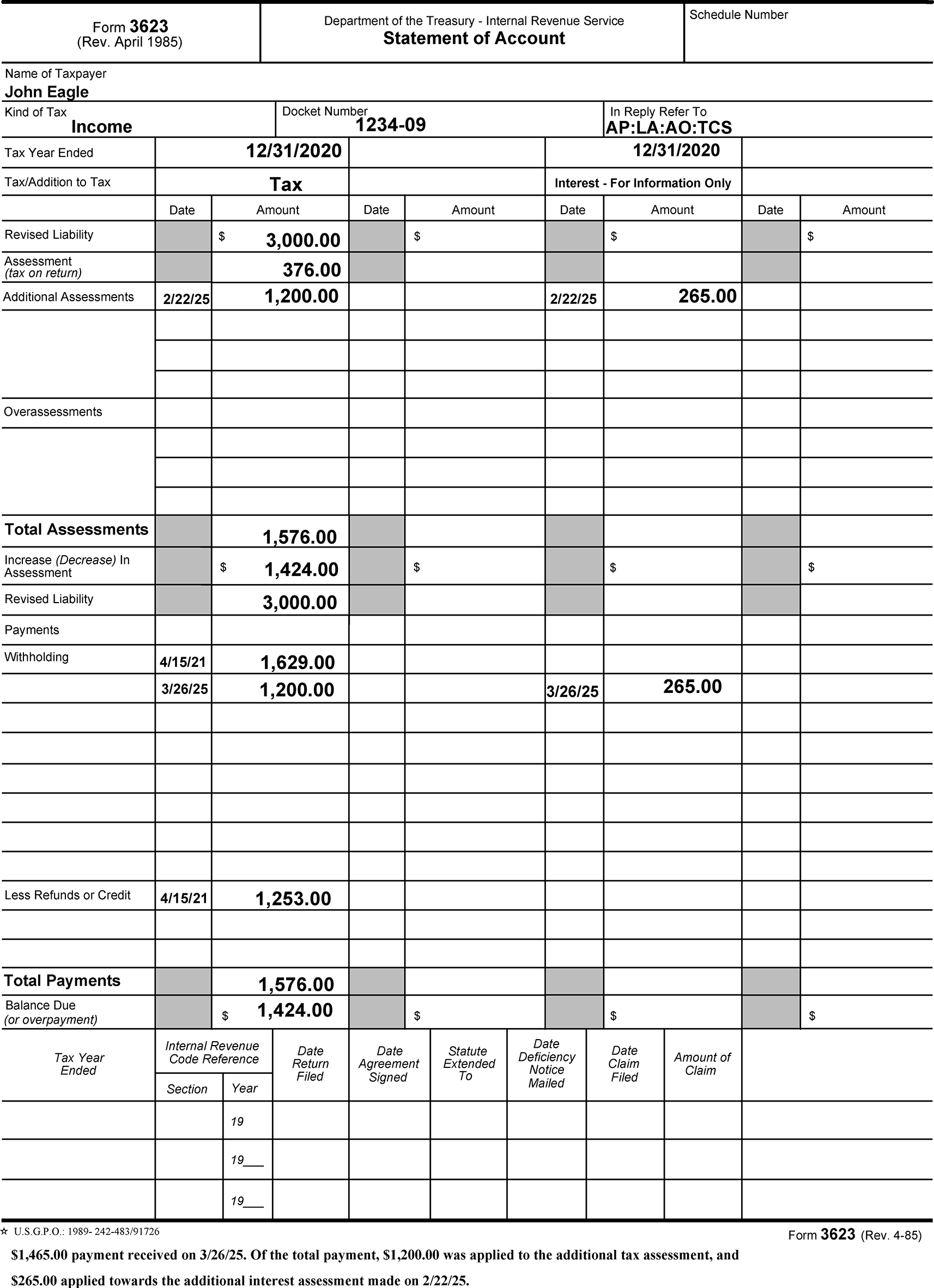
Note to TCS: The statement of account was prepared for this case because there was an interim assessment and interim payment on the taxpayer's account.
Please click here for the text description of the image.
Please click here for the text description of the image.
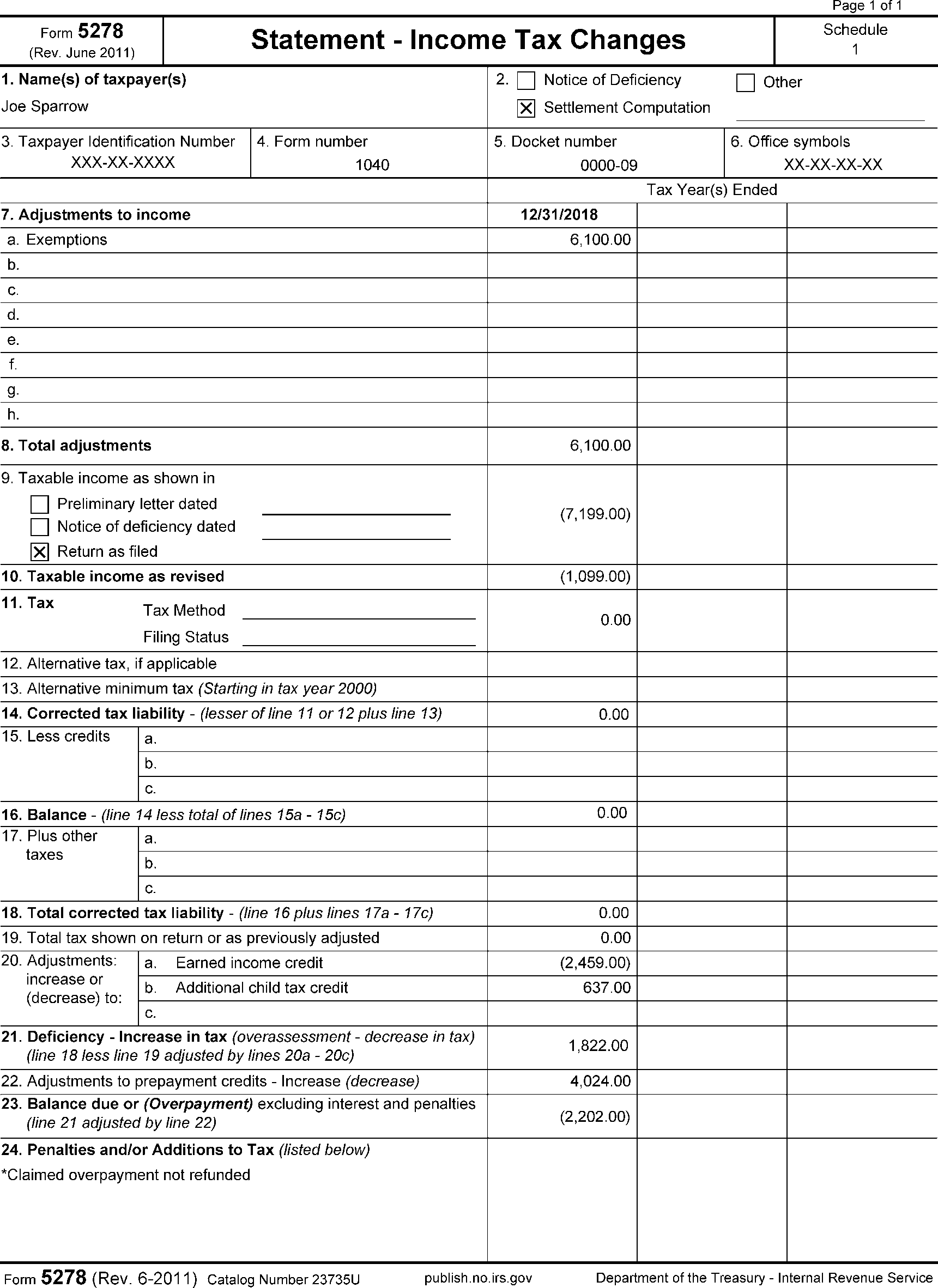
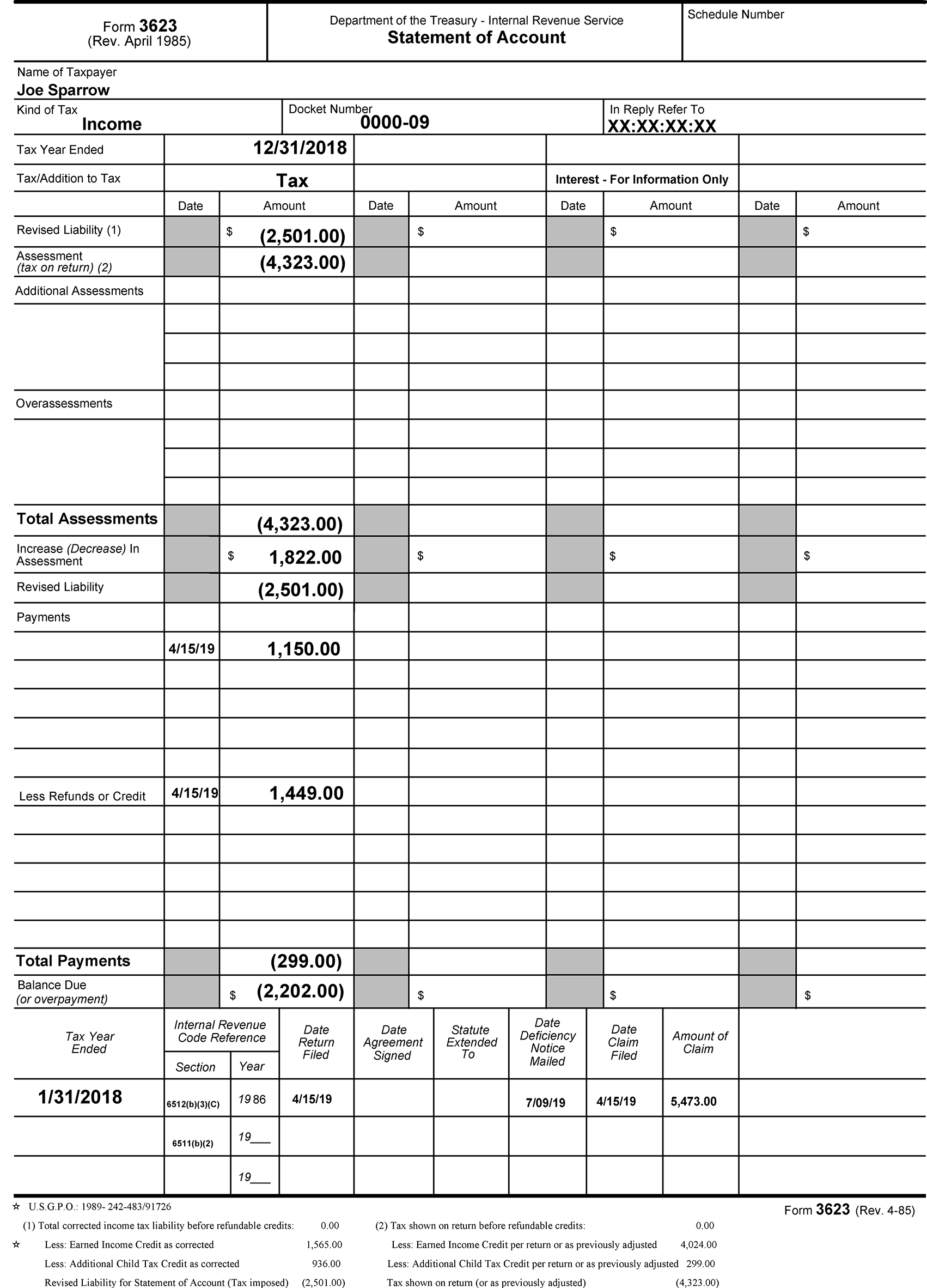
| Notes to TCS about Form 5278 and Form 3623 |
|---|
| Form 5278: |
| 1. EIC per return of $4,024 less EIC as corrected of $1,565 equals the $2,459 decrease in EIC. |
| 2. ACTC per return of $299 less ACTC as corrected of $936 equals the increase in ACTC of $637. |
| Form 3623: |
| 1. The IRC 6211 deficiency is the increase in tax after the EIC and ACTC adjustments. The Form 5278 shows a decrease to EIC of $2,459.00 and an increase to ACTC of $637.00. This is the $1,822.00 shown on the "Increase (Decrease) in Assessment" line on the statement of account. |
| 2. The $1,822.00 amount will be processed as a two step adjustment. $2,459.00 of the EIC claimed on the return will be reversed and $637.00 will be allowed as an increase to the amount of ACTC claimed on the return. This will result in the net deficiency of $1,822.00. |
| 3. The allowable credits (EIC of $1,565.00 and the allowable ACTC of $936.00) are not shown in the list of payments in the bottom part of the statement of account since these amounts are considered in the "Revised Liability" line (1). |
| 4. The "Less Refunds or Credit" line in the bottom part of the statement of account will include any EIC or ACTC refunded to the taxpayer. In this example, the withholding credit of $1,150.00 and ACTC claimed on the return of $299.00 was refunded to the taxpayer; a total of $1,449.00. The EIC claimed on the return of $4,024.00 was not refunded to the taxpayer. This part of the taxpayer's claimed refund was held and the refund frozen. |
| 5. Balance due (or overpayment): In this example, there is a net overpayment of $2,202.00, even though there is an increase to tax in the amount of $1,822.00. However, since the campus held $4,024.00 of the taxpayer’s claimed refund (frozen refund), the taxpayer is entitled to a refund of $2,202.00. |